









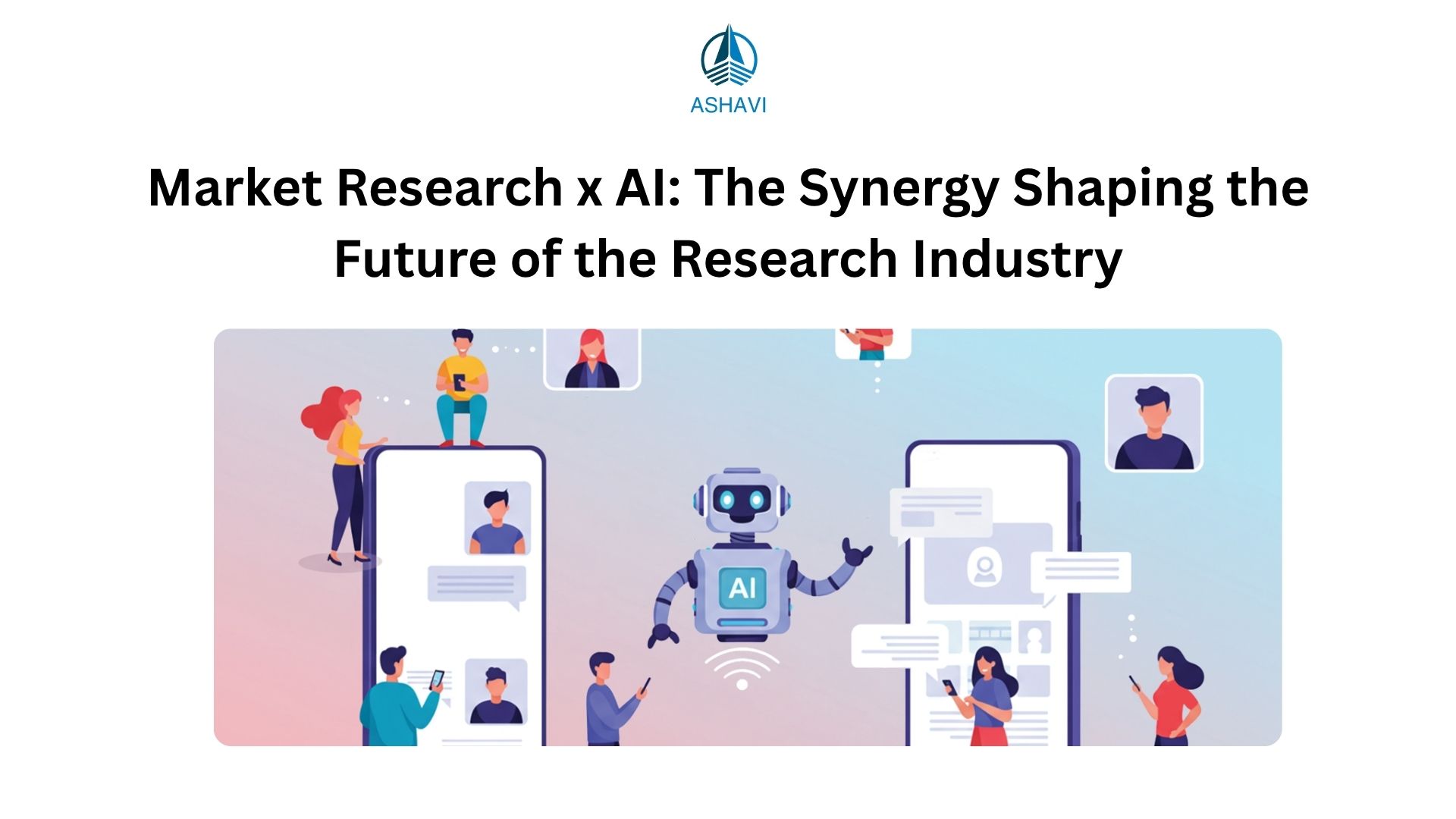
In a business environment that is shifting faster than ever, the intersection of market research and artificial intelligence (AI) is becoming not just advantageous, but essential. The title of this article — “Market Research x AI: The Combination Defining the Future of the Research Industry” — encapsulates a transformative dynamic: how traditional methodologies of market research are being completely re-imagined by the integration of AI and how that re-imagining in turn will shape what the industry looks like in the coming years.
Market research has for decades been a cornerstone of strategic decision-making: gathering data on customers, competitors, markets, trends, and then interpreting that data into actionable insights. But the context today is dramatically different. The volume of data available is unprecedented; the pace of change in consumer behaviour, technology and markets is accelerating; and the expectations on research teams to deliver faster, deeper, more predictive insights — not just descriptive ones — is growing.
At the same time, AI has moved from theoretical curiosity to core business capability. According to the Stanford Institute for Human-Centered Artificial Intelligence AI Index 2025 Report, business adoption of AI is surging and is increasingly embedded in everyday operations. Meanwhile, the global AI market is projected to reach USD 3,497.26 billion by 2033 — growing at a compounded annual growth rate (CAGR) of 31.5 % from 2025 to 2033.
Together these shifts mean that market research can no longer rely on legacy methodologies alone. There is a pressing need for new tools, new mindsets, and new workflows — and AI is playing a central role in that evolution.
The integration of AI into market research is far more than a superficial upgrade. It is changing what is possible. Research by the Columbia Business School shows that generative AI is enabling four distinct classes of opportunities within market research:
Supporting existing practices — making traditional survey-data collection, coding, and analysis faster, cheaper or more scalable.
Replacing traditional practices — for example, using synthetic data (created by AI) in lieu of certain primary research methods.
Filling insight gaps — enabling companies to gain knowledge that they previously couldn’t (for example, by mining unstructured data or modeling scenarios that were too expensive to test).
Creating entirely new applications — such as “digital twins” of customer behaviour, real-time automated micro-surveys, or conversational AI interviewers.
In addition to this framework, a recent blog post by MarketResearch.com emphasises that AI is a revolutionary asset for analysis, but it is not a full replacement for human-led, high-quality market research. The post states:
“While artificial intelligence is a revolutionary asset for analysis, it is not and should not be a replacement for the deep, methodical work of market research reports.”
This highlights that the future of market research is less about AI versus human researchers, and more about AI plus human expertise.
When effectively integrated, AI brings a range of benefits to market research teams. Some of the most important include:
Speed and scalability: AI tools can process vast volumes of data (surveys, social posts, transcripts, sensor data) far more quickly than manual methods.
Predictive and prescriptive capabilities: Rather than simply describing what happened (“descriptive”), AI enables “what-may-happen” modelling (“predictive”) and even “what should we do?” recommendations (“prescriptive”).
Handling unstructured and alternative data sources: Traditional market research often relied on structured survey data; now AI enables the analysis of social media comments, image data, voice transcripts, sensor data, and other unstructured forms — opening up richer insight possibilities.
Cost efficiency and continuous monitoring: AI can enable ongoing, near-real-time tracking of markets and consumers (instead of a snapshot every quarter). It reduces the reliance on expensive manual methods (focus groups, in-person interviews) for every insight need.
Enhanced decision support: By automating parts of the research pipeline (data collection, cleaning, preliminary analysis), AI frees human researchers to focus on strategic tasks: framing the right questions, interpreting the “why”, applying context, making recommendations.
There are numerous emerging use cases showing how AI is reshaping market research. A few illustrative ones:
Survey automation & conversational interviewing: Companies are deploying virtual interviewers (chatbots or voice bots) powered by AI to conduct respondent interviews, transcribe and code responses in real time, and surface themes or anomalies.
Social listening and sentiment analysis: AI tools scan large volumes of social media, forums, review sites and extract sentiment trends, emerging issues and competitor signals.
Synthetic respondents and scenario modelling: Some pioneering firms are now using synthetic data (AI-generated responses based on models of consumers) to supplement or partially replace traditional panels.
Real-time dashboards and dynamic visualizations: Rather than waiting for a final report, teams can deploy AI-powered dashboards that continuously update insight as data flows in, enabling more agile decision-making.
Predictive trend detection and early warning: AI can detect weak signals in data (for example, rising dissatisfaction about a product feature, or shifting cultural attitudes) earlier than classical research methods.
Competitive intelligence and market scanning: AI can automate scanning of patent filings, technical publications, regulatory notices, news articles and social posts to identify emerging competitor moves or market entrants.
For businesses and research organisations, the AI-driven shift in market research implies several strategic imperatives:
Rethink research workflows: Traditional workflows (brief → instrument design → data collection → analysis → report) are being disrupted. Research teams must integrate AI tools earlier (e.g., during instrument design, real-time monitoring) and adopt more iterative, agile approaches.
Build AI literacy and hybrid competence: Researchers must become fluent in the capabilities and limitations of AI. They must understand how to work alongside AI — framing the right questions, interpreting AI-generated insights, and applying human judgement.
Ensure data quality, governance and ethics: Because AI draws on large datasets, there is increased importance on data integrity, bias avoidance, transparency and ethics. Market research organisations must ensure that AI tools are not replicating skewed samples or amplifying bias.
Focus on strategic insights and storytelling: While AI can automate much of the grunt work, human researchers must focus more sharply on interpretation, context, the narrative of “why this matters”, and strategic recommendation.
Adapt business models: With increased automation and real-time capabilities, research providers may shift from one-off reports to continuous insight-as-a-service models. Clients may expect faster turnarounds, more interactive dashboards, more self-service capabilities.
Stay ahead of the tool ecosystem: There are dozens of AI market-research tools emerging — firms must evaluate and adopt tools that align with their research methodologies.
It would be naïve to assume that AI is a panacea for every research challenge. There are real risks and limitations:
Quality of data and representativeness: AI tools are only as good as the data they are trained on. If data is biased, incomplete or unrepresentative, the insights will be flawed.
Loss of “why” and nuance: AI can identify patterns, but human researchers are still needed to interpret why something is happening, to validate it, to understand cultural or emotional drivers.
Over-reliance on automation: There is a risk that teams may rely too heavily on AI-generated “answers” without critically questioning them. AI can hallucinate, mis-classify, or extrapolate inappropriately.
Ethical and privacy concerns: Collecting and analysing large volumes of data (including unstructured conversations, social posts, images) raises issues of consent, privacy, bias, and fairness.
Change management and skills gaps: Organisations may struggle to embed new AI tools if their people, processes and culture are grounded in older ways of doing research. Adoption requires investment in training, process redesign and mindset shifts.
Cost of innovation and tool proliferation: While some AI tools lower cost, others may require substantial investment, integration, customisation and oversight. Choosing the right tool and proving ROI is still a challenge.
Client expectations and communication: Delivering faster and AI-powered insights may raise client expectations for quick turnarounds and “answers”. But research still needs proper framing, methodology, caveats and interpretation — which take time.
So what does the future hold for market research when AI becomes deeply embedded? Here are a few potential developments:
Continuous insight streams: Rather than periodic reports, organisations will have live insight dashboards that update as data flows in.
Micro-targeted, real-time research: Research will be more granular: for example, micro-surveys delivered to niche segments, real-time sentiment tracking for new product launches, dynamic adaptive questionnaires adjusted on-the-fly by AI.
Hybrid human-AI research teams: Research teams will increasingly be structured as hybrid groups — data scientists, market researchers, behavioural scientists, storytellers — working together.
Predictive strategy and simulation: Market research will shift further upstream towards predictive strategy: modelling scenarios, running simulations, testing “what-if” questions. AI will power these models.
Democratisation of research: With powerful AI tools, smaller companies may gain access to research capabilities previously reserved for big firms.
New methodologies and data sources: We will see more use of synthetic data, AR/VR research environments, conversational AI interviewers, image/video analytics, sensor data.
Ethics, trust and transparency as differentiators: As research becomes more automated and data-driven, the differentiators will be trust, transparency of methods, robust ethics, and human-centred interpretation. Organisations that can combine AI speed with human insight will lead.
For businesses, academic institutions, and research vendors wanting to position themselves for the future, here are some recommended actions:
Audit current research workflows: Identify where manual bottlenecks exist and where data sits unused.
Pilot AI tools thoughtfully: Select a clear use-case and pilot an AI tool. Track metrics such as speed, cost, and insight depth.
Train research teams: Develop capability in data science, AI literacy, hybrid workflows.
Ensure data strategy and governance: Build a clean data architecture and ensure privacy and bias controls.
Communicate the new value proposition: Position research not just as “reports” but as ongoing insight-streams and predictive modelling.
Partner where needed: Collaborate with AI or data specialists to accelerate adoption.
Monitor ethics and methodology: Maintain human oversight, validation, and transparent methods.
The convergence of market research and artificial intelligence is not just an incremental improvement — it is a profound shift in how we gather, analyse and act on market insight. In the past, research might have meant commissioning a survey, waiting for results, analysing and delivering a report weeks later. In the future, it means continuous streams of data, real-time insight, scenario modelling, faster decision-making — and it will require new skills, new tools, new mindsets.
AI offers vast benefits: speed, scalability, new sources of data, and predictive capability. But these benefits come with caveats: the need for human insight, the need for quality data and ethical guard-rails, and the need to redesign workflows and build new capability.
For organisations willing to invest in the journey, the future of market research is bright: more agile, more integrated with strategy, more responsive to change, and more accessible. The synergy of human expertise plus AI capability will define the winners in the research industry.
In short: if market research wants to stay relevant and thrive, it must embrace AI — not as a threat, but as an enabler — and design a future where insight is faster, richer, predictive, and seamlessly integrated into business strategy. The era of “market research or AI” is over. The era of “market research x AI” — the multiplication of capabilities — is here.